
When Cardiogenic Shock Goes Undocumented: The Clinical and Financial Cost
Blog

A missed or unrecorded diagnosis affects the patient first, and the hospital’s ability to care for the next patient soon after.
In a busy cardiac ICU, cardiogenic shock is often managed before it is named. Pressors are titrated, labs are trended and the team responds to what the patient’s physiology is telling them. But the diagnosis that explains all of that care may never be entered in the chart. The result is a record that understates the patient’s illness, and a hospital reimbursed as if the case were routine.

The clinical gap
Cardiogenic shock remains a major challenge for hospitals, largely because delayed recognition contributes to poor outcomes. Even with significant progress in interventional cardiology, one-year mortality often approaches or exceeds 50%. According to the American College of Cardiology, survival improves markedly when shock is recognized in its initial stages, before multi-organ failure sets in, and timely recognition can also ease the strain of prolonged ICU stays and extensive interventions.¹
Recognition is difficult because shock often develops gradually. Changes in heart rate, blood pressure and respiratory rate may seem innocuous at first.² Even in cardiac ICUs, newer nurses and advanced practice providers may be managing complex, high-acuity patients while physicians are stretched across competing tasks. In their review of cardiogenic shock phenotypes, Tehrani et al. found that best practices remain nonuniform across the United States, and that timely diagnosis, triage and risk classification improve prognosis.³
The financial gap
The consequences extend to hospital operations. Under Medicare Severity-DRGs, each base DRG is divided into three tiers: without a complication or comorbidity, with a complication or comorbidity (CC), and with a major complication or comorbidity (MCC).⁴ CMS lists cardiogenic shock as an MCC when the patient is discharged alive. When it is correctly coded as a secondary diagnosis, the case moves into a higher-weighted DRG that better reflects the true cost of care.
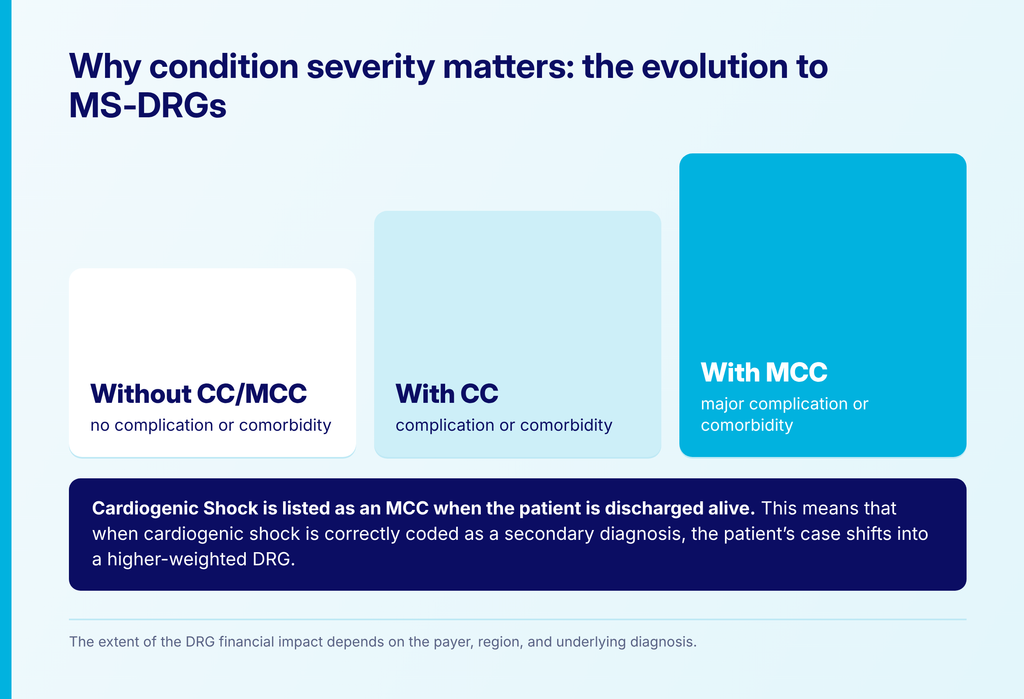
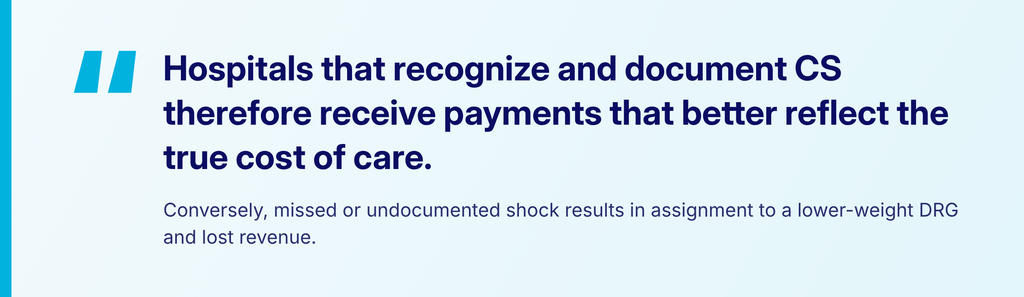
Hospitals are paid a fixed amount for each DRG regardless of actual cost, so the model depends on documentation that accurately reflects illness severity. When shock is missed or never recorded, the case is assigned to a lower-weight DRG. The size of the difference varies by payer, region and underlying diagnosis, but unrecognized or undocumented cases often mean significant lost revenue.
Evidence while the patient is in care
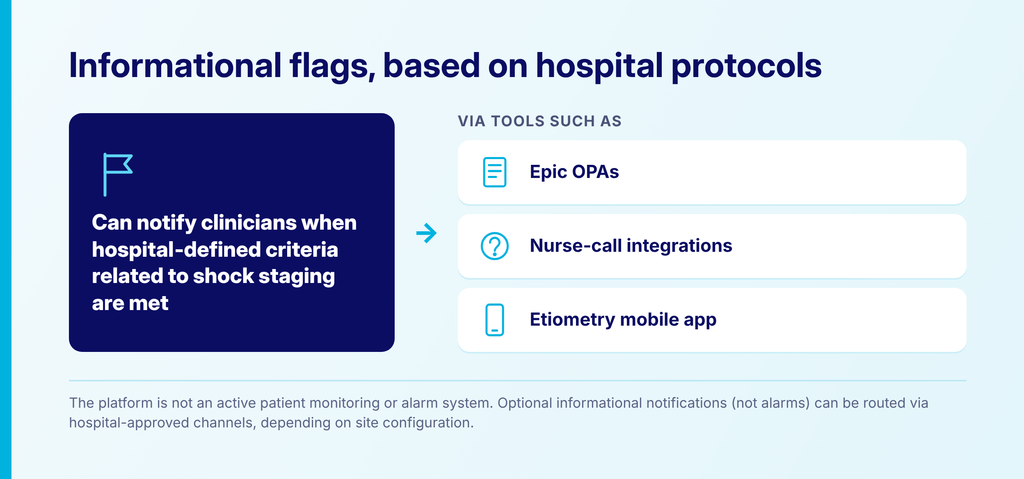
EHRs typically record information retrospectively, which makes it difficult to see shock as it evolves. The Etiometry Platform, used in more than 175 ICUs, integrates with existing EHRs and bedside devices and applies each hospital’s own SCAI and shock staging criteria. It displays stage progression and regression across the hospital, flags patients who meet hospital-defined criteria for risk review, and can send optional informational notifications through hospital-approved channels such as Epic OPAs, nurse-call integrations or the Etiometry mobile app.
With timely visibility into shock staging, clinicians can assess the patient and document what they find. Accurate documentation is ultimately a matter of telling the patient’s story fully, and reimbursement, quality reporting and resource planning follow from it.
Optional informational notifications (not alarms) can be routed via hospital-approved channels, depending on site configuration. The Etiometry Platform is not an active patient-monitoring or alarm system, does not replace bedside monitoring and does not diagnose or predict clinical events. It is a clinician-configured decision-support tool and does not independently identify or treat cardiogenic shock.
Source: Etiometry White Paper: Unrecognized Cardiogenic Shock: A Costly Gap in Hospital Care (ETI-WP-CS-COST-001). References: ¹ Sinha S, et al. 2025 ACC Expert Consensus Statement on the Evaluation and Management of Cardiogenic Shock. JACC. 2025;85(16):1618–1641. ² AI in the Early Prediction of CS in Acute Heart Failure or MI Patients: A Systematic Review and Meta-Analysis (PMC10783597). ³ Tehrani BN, et al. A standardized and comprehensive approach to the management of cardiogenic shock. JACC Heart Fail. 2020;8:879–891. ⁴ AHRQ HCUP, APS-DRGs Definitions Manual v27.
Related

How Documentation, Length of Stay and Capacity Shape Cardiac Surgery Margins
What four years of CABG data from one cardiothoracic ICU suggest about each. Most patients recover from coronary artery bypass grafting along a familiar path: extubation, vasoactive weaning, transfer to the floor, discharge. For some, the postoperative course brings respiratory failure, acute kidney injury or cardiogenic shock. Those complications shape the patient’s recovery, and they […]
What Continuous Physiologic Data Reveals About Cardiogenic Shock
A retrospective analysis compared cardiogenic shock staging built from charted values with staging built from continuous data. The differences were clinically meaningful. In one patient’s record from the analysis, the chart shows a mean arterial pressure of 71 mmHg, and an hour later, 66 mmHg. Read on their own, the two values suggest a patient […]
SCAI Staging and the Growing Role of AI in Cardiogenic Shock Care
A shared framework has given shock care a common language. Applying it consistently is where clinicians are beginning to look for support. Cardiogenic shock is defined by critically reduced cardiac output and the end-organ hypoperfusion that follows. Despite decades of progress in interventional cardiology, short-term mortality still ranges from 30% to 40%, and one-year mortality […]