
Risk Analytics
FDA-cleared risk indices that help support ICU teams in making escalation and de-escalation decisions
Etiometry’s risk indices are adjunctive, FDA-cleared algorithms that continuously calculate the probability of an adverse physiologic state in a critically ill patient, tracking changes in patient trajectory, including progress toward recovery. Each index combines multiple physiologic measures and laboratory results into a single probability, displayed alongside the underlying trend data, so care teams can review changes in patient status in context.
The indices were developed using more than 150 million hours of de-identified patient data and support clinician-directed, personalized escalation and de-escalation decisions within hospital-defined workflows.
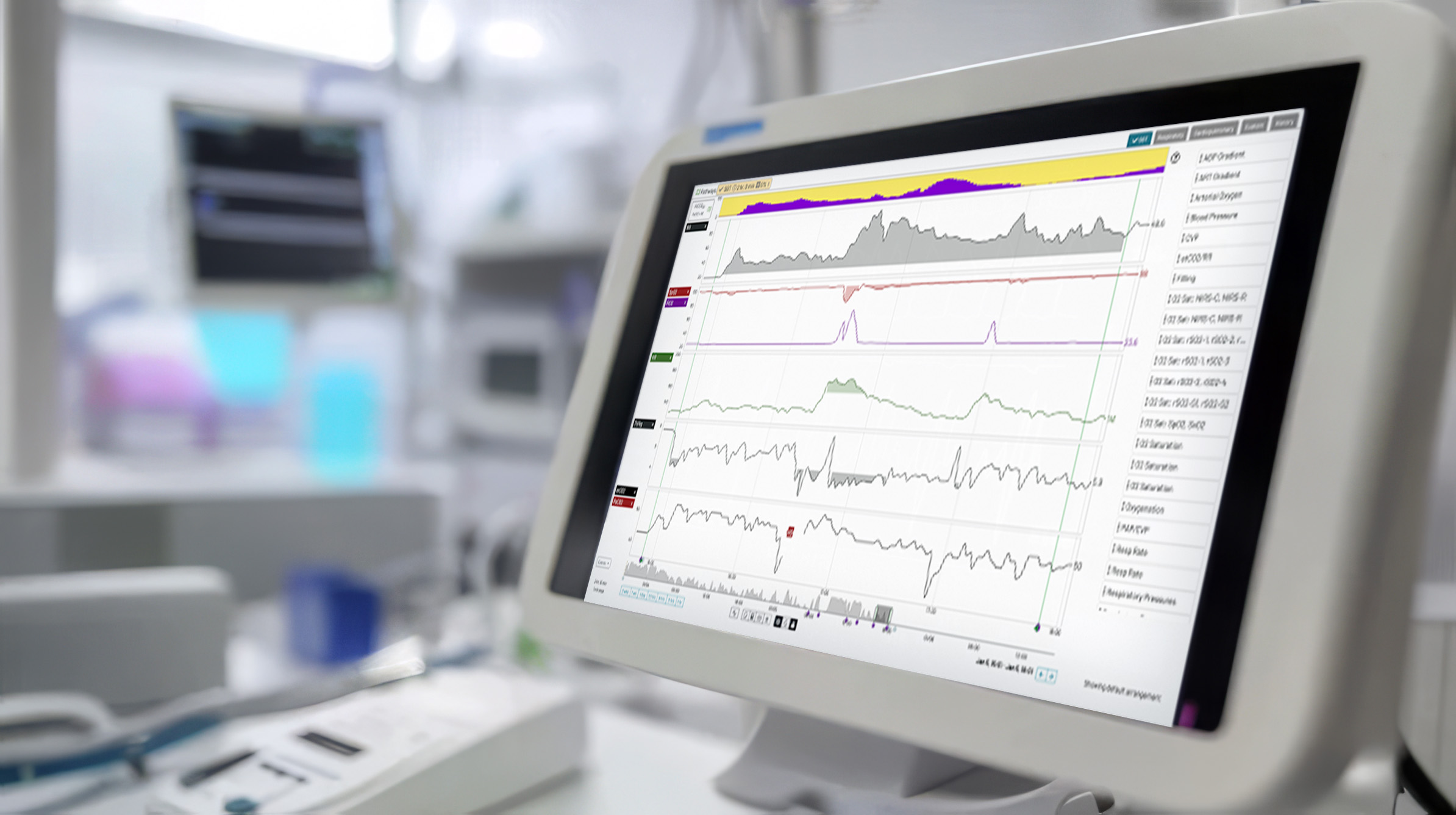
real time, giving care teams an objective view of patient trajectory to support
proactive, individualized escalation and de-escalation.
How do the risk indices bring attention to changes in patient status?
In intensive care settings, most serious changes in a patient’s physiologic state often develop gradually rather than suddenly, with abnormal vital signs often detectable long before significant events. Continuous physiologic and laboratory monitoring generates vast amounts of data, and clinicians must constantly decide which signals warrant immediate review.
Etiometry’s risk indices process that data continuously, using proprietary models of human physiology to interpret patient-generated data into patient-specific index values. Each index synthesizes multiple physiologic and lab inputs into a single probability that highlights patients who may warrant closer clinical review, bringing timely awareness to subtle trends toward an adverse physiologic state.
How can clinicians see what drives an index value?
Each index is built on established physiologic parameters and published clinical thresholds. The platform shows clinicians which physiologic inputs are driving an index value, alongside the direct measurements, so they can question the output or spot a sensor anomaly. The clinician stays in charge.
Clinicians can also select a patient-centered threshold for the IDO2 and IVCO2 indices, which gives a more meaningful baseline for an individual patient’s condition.
FDA clearance adds a further layer of transparency. Cleared algorithms must have documented indications for use, validated performance data and a clearly stated scope.
How do the indices support escalation as well as de-escalation?
Staying on interventions longer than necessary carries risks, and knowing when to safely step back is as demanding as deciding when to escalate. The indices provide adjunctive, continuous assessment that supports both.
For de-escalation, the IDO2 Index gives care teams a continuous data stream to inform clinician review of vasoactive weaning readiness, alongside direct measurements and other clinical data. Institution-configured extubation readiness pathways within the platform identify patients who meet hospital-defined eligibility criteria and continuously evaluate the patient’s response against hospital-defined thresholds.
How do the indices fit into the care team’s workflow?
The indices run inside the Etiometry Platform, which aggregates near real-time physiologic data from supported bedside devices into one patient view. The platform’s aggregated display supports rounds conversations with physiologic context that is continuously updated rather than episodically charted, and gives charge nurses and unit leaders a view of acuity across the unit.
The Etiometry Platform is adjunctive. Its outputs supplement clinician judgment, alarms and monitoring devices. They do not replace them.
Adjunctive and continuous assessment of the risk of patient deterioration, facilitating both escalation and de-escalation decisions
Inadequate Delivery of Oxygen: Etiometry IDO2 Index™
Inadequate Ventilation of Carbon Dioxide:
Etiometry IVCO2 Index™
Hyperlactatemia:
Etiometry HLA Index™
Acidosis:
Etiometry ACD Index™
The four indices are cleared together under FDA 510(k) [K241479], which also covers the platform’s cybersecurity controls under FDA Section 524B. Clearance details are available in the FDA 510(k) database.
What the evidence shows
Published observational studies at select sites have examined what happens when care teams have continuous, aggregated physiologic data and adjunctive risk indices available to inform their rounding and transition discussions.
- ICU length of stay: one study reported a 36% reduction in ICU length of stay after congenital heart surgery when a real-time physiologic analytic index was used.[1]
- ICU readmissions: sites using the platform to support informed assessment during rounds and discharge planning observed a 41% reduction in unplanned ICU readmissions and an 18% reduction in ICU length of stay.[2]
- Vasoactive weaning: use of the IDO2 Index to support clinician review of vasoactive weaning readiness was associated with a 29% reduction in time with vasoactive infusion.[3]
- Extubation readiness: use of an automated extubation readiness pathway was associated with a 30% reduction in time on mechanical ventilation.[4]
- Extubation failure: elevated IDO2 and IVCO2 before extubation were associated with increased risk of extubation failure in neonates following congenital heart surgery.[5]
These are observational findings. They do not establish causality, and results vary by site and patient population. The Etiometry Platform is intended to aid decision-making, not to improve outcomes independently.
See the full list of studies on the Clinical Research and Outcomes page.
FAQ
The Etiometry platform includes IDO2, IVCO2, HLA, and ACD indices, covering oxygen delivery, inadequate ventilation of carbon dioxide, hyperlactatemia and acidemia.
Etiometry has four FDA-cleared adjunctive risk indices (IDO2, IVCO2, ACD, HLA) for ICU use per their indications. The Etiometry Platform holds 11 FDA clearances in total, covering the indices, their expanded indications and the Cardiogenic Shock Tool.
No, the Etiometry platform is not an active monitoring system and is designed to supplement‚ not replace‚ patient monitoring.
The indices process physiologic and laboratory data continuously and synthesize it into a single probability of an adverse physiologic state. This highlights subtle trends that may warrant closer clinical review.
Yes. Each index is built on established physiologic parameters and published clinical thresholds, and the platform shows which physiologic inputs are driving a risk signal alongside the direct measurements. Clinicians can question the output or identify a sensor anomaly.
The indices are adjunctive AI. They supplement clinician judgment and show their reasoning. A black-box model gives an output without explaining how it got there. FDA clearance also requires documented indications for use, validated performance data and a clearly stated scope.
The IDO2 Index is indicated for adult patients and patients under 12 years with weights above 2 kg. The IVCO2 Index is indicated for invasively mechanically ventilated patients 0 days to 12 years.
Yes. The IDO2 Index gives care teams a continuous data stream to inform clinician review of vasoactive weaning readiness, and institution-configured extubation readiness pathways within the platform evaluate a patient’s response against hospital-defined thresholds. In observational studies, these workflows were associated with a 29% reduction in vasoactive infusion duration and a 30% reduction in time on mechanical ventilation.
The indices were originally developed and validated in cardiac intensive care, and the published outcome studies are in patients following congenital heart surgery. For cardiogenic shock, the Etiometry Platform also includes the FDA-cleared Cardiogenic Shock Tool (K254066), which automates hospital-specific SCAI staging from physiologic monitoring data.
References
- Salvin JW, et al. The Impact of a Real-Time Physiologic Data Analytic Index on Length of Stay in Neonates Following Surgery for Congenital Heart Disease. Circulation. 2017. https://www.ahajournals.org/doi/10.1161/circ.136.suppl_1.20603
- Gaies M. Methods to Enhance Causal Inference for Assessing Impact of Clinical Informatics Platform Implementation. Circ Cardiovasc Qual Outcomes. 2023. https://www.ahajournals.org/doi/10.1161/CIRCOUTCOMES.122.009277
- Gazit AZ, et al. Risk Analytics Clinical Decision Support Decreases Duration of Vasoactive Infusions Following Pediatric Cardiac Surgery. Crit Care Med. 2025. https://journals.lww.com/ccmjournal/abstract/2025/07000/risk_analytics_clinical_decision_support_decreases.1.aspx
- Clark MG, et al. Automated Spontaneous Breathing Trial Performance Tool is Associated with Improved Outcomes Following Pediatric Cardiac Surgery. J Pediatr Crit Care Med. 2025. https://journals.lww.com/jpcr/fulltext/2025/01000/automated_spontaneous_breathing_trial_performance.1.aspx
- Hames D, et al. Extubation Failure in Neonates Following Congenital Cardiac Surgery: Multicenter Retrospective Cohort, 2017–2020. Pediatr Crit Care Med. 2025. https://journals.lww.com/pccmjournal/abstract/9900/extubation_failure_in_neonates_following.435.aspx
Notes
- Etiometry’s IDO2 Index™ is solely indicated for use for adult patients and patients under 12 years with weights above 2 kg.
- Etiometry’s IVCO2 Index™ is solely indicated for use for invasively mechanically ventilated patients 0 days to 12 years.
- The Etiometry Platform is not an active patient monitoring system. It is intended to supplement and not replace any part of the hospital’s device monitoring. Do not rely on the Etiometry Platform as the sole source of patient status information. For prescription use only.