We have a nurse’s PEACE OF MIND in mind
Automate escalation and de-escalation decisions – safely and efficiently – with the Etiometry Clinical Intelligence Platform
See why 88% of nurses say Etiometry makes their jobs easier. 1

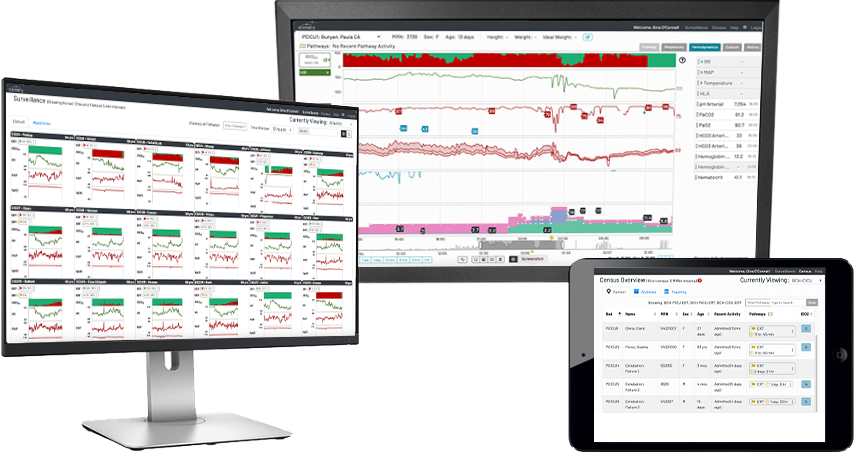
See subtle changes in a patient? With Etiometry, view trended patient data on one screen to help with clinical decision making.

Etiometry can:
Help newer nurses thrive
Support your quality initiatives
Help mitigate patient safety risks
Reduce cognitive load, and more
How nurses use the Etiometry platform
Comprehensive Patient Insights
Gain a deeper understanding of your patients’ conditions with real-time data aggregation and analytics, including hemodynamics, ventilation, and more.
Advocate for patients
Back up concerns about your patient with trended visualized data. Easily navigate to the current vital sign trends and compare them to the more longitudinal trend of the vital sign(s) in question.
Mitigate risks
Anticipate clinical deterioration before it happens with our advanced algorithms that analyze
trends and patterns in patient data, allowing for timely interventions and improved outcomes
Automate clinical pathways
Embedded protocols can inform the care team when a patient is eligible for a care escalation or de-escalation decision.
Teaching cases
Review events in the Quality Improvement App to upskill newer staff
Quality initiatives
Automate quality reports and refine and enhance standardized workflows using actionable data from the platform’s Quality Improvement App.
Seamless communication among the care team
Facilitate seamless collaboration among interdisciplinary teams with our intuitive platform,
ensuring that everyone involved in patient care is on the same page.
Shift Reports
Easily hand off between shifts by using Etiometry as a visual aid. This helps to level set and understand the impact of interventions, the overall baseline for vital signs etc.
Making assignments
A charge nurse can easily see the “hot spots” or higher acuity patients by glancing at the platform’s surveillance view. This may help more effectively spread resources and assign the right nurse to the right patient in terms of any experience/acuity gaps with newer staff or traveling nurses.
Documentation
Refer to the Etiometry platform as a tool to help complete documentation and maintain accurate records of care.
Citation: 1. Lowry, NASA TLX survey analysis from PCICS abstract
-
The Documentation Gap Nobody Talks About — And What It’s Costing Your ICU
Every ICU has a documentation problem. Most don’t know the full scope of it. Clinical events happen continuously in high-acuity care — hemodynamic shifts, ventilatory changes, transient complications that resolve before the next chart entry. Clinicians respond to them. They manage through them. And then, in the relentless pace of the ICU, those events may […]
-
Beyond Escalation: How Clinical Intelligence Supports ICU De-Escalation Decisions
In high-acuity care, clinical attention naturally gravitates toward escalation: adding interventions, increasing support, responding to deterioration. But the other half of intensive care, knowing when and how to safely step back from those interventions, is equally demanding and equally consequential. Prolonged mechanical ventilation, extended vasoactive support, mechanical circulatory support (MCS) and delayed discharge carry real […]
-
Cardiogenic Shock in Cardiac Surgery Patients: Why Continuous Physiologic Data Matters
Cardiac surgery patients don’t come from a single mold. A valve repair patient, a transplant recipient, a CABG patient, and a patient recovering from aortic surgery each carry a different hemodynamic profile and a different trajectory through the ICU. What they share is vulnerability, particularly to one of the most dangerous complications in post-surgical critical […]